
Skin Guide · Sep 2026
Skin Guide
What a before and after cannot tell you
Two photographs, months apart. Almost everything between them is not the treatment.
Read
the
pair
Maylin Apgujeong
Model portrait
Not a patient
Skin Guide · Juvelook
Juvelook before and after: what the photographs can and cannot tell you
Searching for Juvelook before and after photographs is a reasonable thing to do before booking anything. It is also the point at which most people are misled, and usually not on purpose. Here is how to read a pair, and what a collagen stimulator result does and does not look like in a photograph.
Maylin Apgujeong · Skin Guide
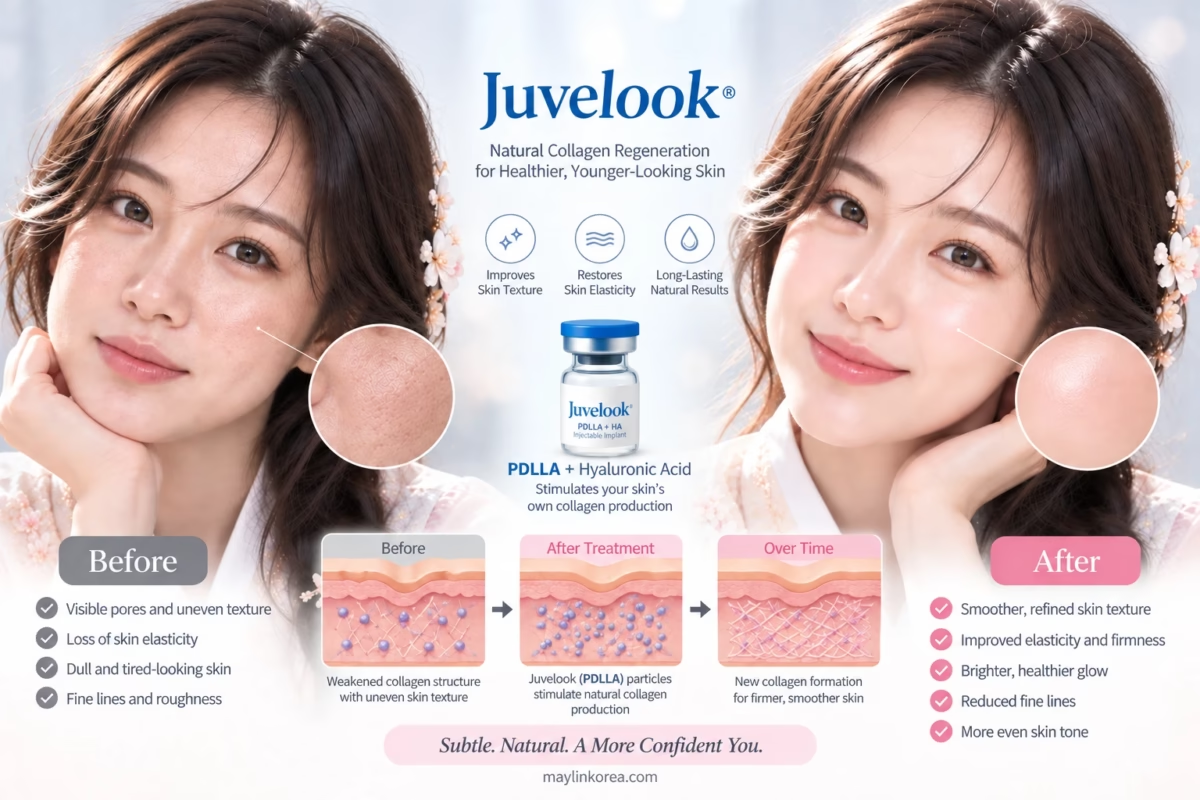
Move a lamp from above the face to slightly in front of it and a nasolabial fold will soften without anyone touching it. Raise the chin two centimetres and a jawline tightens. Change the lens from 35mm to 85mm and the nose narrows. None of that is a result. All of it is photography.
This is worth knowing before you look at anyone’s gallery, including ours. The question to ask of any pair is not “what changed” but “what else changed”.
The four that matter most
Light, angle, expression, and makeup. Those four account for more apparent difference than most treatments produce. A photograph taken under a clinic’s ring light and one taken beside a window are not comparable, and a relaxed face and a slightly lifted one are not the same face.
Time of day matters too. Faces hold fluid in the morning and lose it by evening. A before taken at nine and an after taken at six are already different before anything else is counted.
What a fair pair looks like
Same light, same distance, same lens, same angle, no makeup on either side, neutral expression on both. If those hold, the pair is worth reading. If you cannot tell whether they hold, the honest conclusion is that you cannot tell: not that the treatment failed, and not that it worked.
The most flattering photograph in any gallery is usually the after. That is worth a moment’s thought.
On reading a gallerySelection is the quieter problem
Even a scrupulously shot pair tells you about one person. Galleries show the cases that went well, which is not dishonest (nobody publishes their disappointments), but it does mean a gallery is a record of best outcomes, not of typical ones.
So treat photographs as a starting point for a question rather than an answer to one. What was done, over how long, on what kind of skin, and how often does it turn out that way. Those are answerable at a consultation. A photograph is not.
When a Juvelook pair should be taken
This one has a specific trap, and it comes from the timeline rather than the camera. Juvelook is a collagen stimulator: the hyaluronic acid in the mix smooths briefly and goes, and the collagen response usually becomes visible somewhere from week four to week eight, then keeps developing after the final session.
Which means a photograph taken at week two shows nothing, and a photograph taken on the day shows the wrong thing: some of that early smoothing is hyaluronic acid and some is simply swelling. A fair Juvelook after is taken months from the last session, not days from the first. We take ours at three months from the final session. If a pair you are looking at does not say when the after was taken, that is the first thing to ask. Our timeline article sets out what happens in each of those weeks.
And what it will look like when it does show
A collagen stimulator changes skin quality rather than contour. Texture, a bit more light coming back off the skin, lines that read as shallower because the skin around them is thicker.
That is genuinely harder to photograph than volume. The kind of change that makes a dramatic before and after is usually the kind this treatment does not make, so a modest-looking pair is not evidence of a weak result. It may be an honestly shot one. A Juvelook pair with a transformed jawline in it is showing you something other than Juvelook.
How ours are taken
Same camera, distance, lighting and head position, every time. No retouching and no filters, and published only with written consent. Each case states the number of sessions and the interval, because a pair without that information is decoration rather than evidence.
Results shown are for one individual, and the same treatment will not produce the same result in everyone. Side effects can occur. Our Juvelook page carries the gallery, and where it currently says the images are awaiting consent and review, that is exactly what it means. We would rather show an empty frame than a borrowed one.
What the standards actually say
The rule that a pair is only readable when the conditions match is not a house preference. It is the long-standing standard in the surgical literature: clinical photographs should be taken with the same camera, lens, lens setting, lighting and patient position, so that a before and an after can be compared at all. DiBernardo BE, Adams RL, Krause J, Fiorillo MA, Gheradini G. Photographic standards in plastic surgery. Plastic and Reconstructive Surgery 1998;102(2):559–568. PubMed 9703100. What it does not show: it is a technique paper from 1998, written for film cameras. It sets out how to take a comparable pair. It does not measure how far an uncontrolled pair misleads the person looking at it.
The recent literature is about the problem rather than the technique. A 2026 review of facial plastic photography standards records that smartphones and social media have introduced variable lighting, filters and digital manipulation that distort results. Abraham-Aggarwal K, Wilson J 4th, Yang AB, Frodel JL. The Evolving Standards for Facial Plastic Photography in the Age of Social Media. Facial Plastic Surgery 2026;42(4):491–495. PubMed 41061759. A 2024 review reaches the same conclusion about a lapse in standards. Thornton SM, et al. Picture Perfect: Standardizing and Safekeeping Clinical Photography in Plastic Surgery. Aesthetic Surgery Journal Open Forum 2024;6:ojae012. PubMed 38510270. What neither shows: both are reviews. They describe the problem and recommend standards; neither puts a number on how much a change of lighting or angle shifts what a viewer sees.
One more limit worth stating, since it applies to all three. None of them is about Juvelook, or about collagen stimulators at all — they are about surgical and facial plastic photography. What they establish is narrower and still useful: the question of how a pair was shot is real enough that the field has written a standard for it, and then had to write it again.
Read next
Why Juvelook is not a filler, which explains what you are looking for in the photographs in the first place, and the delayed nodule question, which no gallery will show you.
General information, not medical advice for your individual case. What is appropriate depends on your history and on an examination. See also our Medical Disclaimer and Medical Review Process.
Published
Medically reviewed by Hyoung Moon Kim, MD, PhD on .
From our channels

YouTube · most watched this season
When BTX Met Energy, EP3 — Can energy devices reverse a botox side effect?
A discussion between our doctors, with English and Japanese subtitles. About botulinum toxin and energy-based devices, not about Juvelook.
Watch on YouTube →

Instagram · what we are posting about now
Shockwave lifting — a new shift in the lifting market
Deep energy delivery with little downtime. A lifting treatment, which is a different question from the one this page answers.
Watch on Instagram →Not sure this is the right treatment?
That is what the consultation is for. We will look at your skin and tell you what we would recommend and what we would leave alone, including if the answer is nothing for now.
Book a consultation