
Skin Guide · Sep 2026
Skin Guide
Week two looks like nothing
The early smoothing fades before the collagen arrives. That gap is the design, not a failure.
Weeks
one to
eight
Maylin Apgujeong
Model portrait
Not a patient
Skin Guide · Juvelook
Why your Juvelook result seems to disappear in week two
It is the message we get most often after a first session, and the answer is almost always the same: it had not started yet. Here is what is happening in each of those weeks, and the one pattern that is worth telling us about rather than waiting out.
Maylin Apgujeong · Skin Guide
Juvelook combines poly-D,L-lactic acid microspheres with a small amount of hyaluronic acid. Those two ingredients work on completely different clocks, and almost every week-two worry comes from mistaking one for the other.
The hyaluronic acid smooths things briefly. The microspheres prompt your skin to build collagen over the following weeks, then break down and leave. So the first thing you see is not the thing you are paying for, and the thing you are paying for has not arrived yet when the first thing goes.
Day one to day three
You look a little smoother than you did in the waiting room. Some of that is the hyaluronic acid holding water. Some of it is ordinary post-injection swelling, which our treatment page puts at one to three days along with any bruising. Neither of those is collagen.
This is also the point at which people photograph themselves and form an expectation. It is the least representative moment of the whole course.
Day seven to day fourteen: the dip
The hyaluronic acid resorbs. The swelling settles. What is left is your skin, plus a scaffold of microspheres that has not yet produced anything you can see in a mirror.
So you look approximately how you looked before, and the honest description is that nothing has gone wrong and nothing has gone away — the loan has been repaid and the earnings have not come in. Our treatment page warns about this before you book for exactly this reason. It is the expected shape of the course, not a bad response to it.
Week four to week eight
This is where change usually becomes visible: skin quality rather than volume, and texture rather than a line being filled. People often describe it as looking rested rather than looking treated, which is the point.
Because it arrives gradually, you are the worst-placed person to judge it. Faces you see every day change without announcing themselves. This is what standardised photographs are for, and it is why ours are taken with the same camera, distance, lighting and head position every time.
And after the third session
The usual course is three sessions about a month apart. The result continues to develop after the last one, because the polymer is still breaking down and clearing while the collagen it prompted stays. The end of the course is not the end of the change, which is why a fair assessment is usually made some months after the final visit rather than the week after it.
What it actually feels like, over time
The timeline, illustrated
Four illustrations follow the course from the first days to the end of a full treatment: the early smoothing, the settling around week two, the weeks when collagen becomes noticeable, and the continued change after the course.

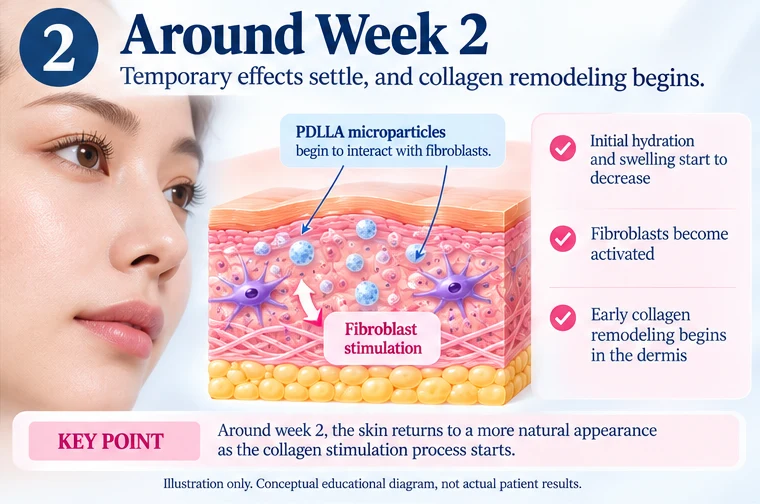

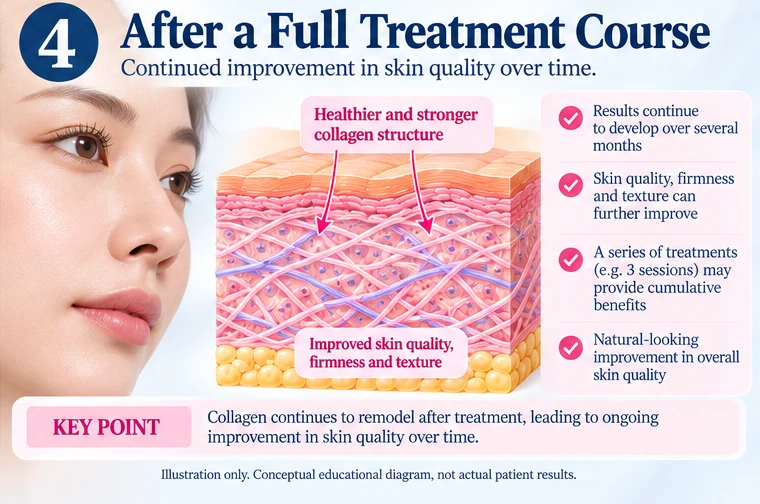
Illustration only. These are conceptual educational illustrations, not actual patient results.
The studies measured this at twenty-four weeks. Nobody publishes a week-two photograph, because week two is not the finding.
On what the evidence actually measuredWhat the studies measured, and when
A randomised, evaluator-blinded multicentre trial compared injectable poly-D,L-lactic acid against hyaluronic acid for nasolabial folds in 260 patients, followed for 52 weeks. At 24 weeks, 67.6 per cent of the PDLLA group had improved by at least one grade on the Wrinkle Severity Rating Scale, against 60.9 per cent for hyaluronic acid. Ting W, et al. Aesthetic Surgery Journal 2024;44(12):NP898–NP905. PubMed 39178357. What it does not show: the product studied is AestheFill, not Juvelook, and patients received a single injection rather than a three-session course. It is evidence for the material, not for this brand or this schedule.
Separately, laboratory work in aged animal skin found that poly-D,L-lactic acid stimulates angiogenesis and collagen synthesis, which supports the mechanism described above. International Journal of Molecular Sciences 2023. PubMed 37175693. What it does not show: it is an animal study, so it explains how the material behaves in tissue without measuring a cosmetic outcome in patients.
Both of those are useful here for a reason that has nothing to do with the percentages. The outcome was read at twenty-four weeks. The timeline is built into how this material is studied, and week two sits well before the first measurement anyone bothered to take.
What not to do in week two
Do not book a top-up out of disappointment. Adding product because the loan has been repaid means treating a normal stage as a shortfall, and the extra volume is still there when the collagen does arrive.
Do not compare photographs taken under different conditions. Morning against evening, window light against bathroom light, phone held closer than last time. Any of those will out-measure the change you are looking for.
Do not judge the course by the first session. Three sessions about a month apart is the usual plan because the response is cumulative.
What is not the normal dip
The dip is symmetrical, painless and boring. It looks like your face before the appointment.
A discrete firm lump, particularly one appearing weeks or months later, is a different matter and is worth telling us about early rather than waiting to see. Redness, heat, tenderness or something changing quickly should be seen sooner still. We cover that in what a delayed nodule is, which is the detail behind the risk our treatment page asks you to read before consenting.
If you are flying home
Dates matter more than most people expect. A treatment whose visible result begins around week four is a different proposition if you fly out in three days and do not plan to return. Say when you leave at consultation, not afterwards — it changes whether a course makes sense for you at all, and if it does, how it should be spaced.
This timeline is one of the things that separates Juvelook from the treatments it gets compared with — Rejuran and an HA skin booster work on different clocks. The short version of the treatment is on the Juvelook page, and the papers cited here are listed with the others on our Sources & References page.
Is one session worth it?
One session can improve texture and give a subtle firmness, especially if your skin is still in good shape. Most of the results people post online come from a series, usually around three sessions. If you are visiting Seoul once, a single session is still reasonable — just expect a gentler change.
Judging your result from home
Because the main change appears weeks later, you will usually judge it after you are home. Take photos in the same light, at the same angle, at one, two and three months. Compare against the photographs taken before treatment, not your memory. What a fair comparison should show at the end of a course is in Juvelook before and after.
FAQ
How soon will I see Juvelook results?
Some smoothness shows in the first days from swelling and hyaluronic acid, then fades. The collagen-driven change usually becomes visible from about four weeks and keeps building.
Is one session of Juvelook worth it?
It can be, for texture and subtle firmness. A series of around three sessions gives the fuller effect.
How many sessions of Juvelook do I need?
Commonly around three, about a month apart, then maintenance. Your doctor sets the plan for your skin.
How much does Juvelook cost?
It depends on product, amount and sessions. We give a clear quote after the consultation.
Maylin Apgujeong is a doctor-led skin clinic in Gangnam: the doctor who examines you plans and carries out the treatment. More in About Maylin Clinic Apgujeong.
General information, not medical advice for your individual case. What is appropriate depends on your history and on an examination. See also our Medical Disclaimer and Medical Review Process.
Published · Updated
Medically reviewed by Hyoung Moon Kim, MD, PhD on .
From our channels

YouTube · from our channel
What to watch out for when botox is combined with energy devices
YouTube short on combining botox with energy-based devices
Watch on YouTube →
Instagram · from our channel
Aiming for results that do not look done
Instagram reel about natural, inconspicuous treatment results
Watch on Instagram →Not sure this is the right treatment?
That is what the consultation is for. We will look at your skin and tell you what we would recommend and what we would leave alone, including if the answer is nothing for now.
Book a consultation