Home›Our Technology›Shockwave Lifting
Carbon Shockwave Lifting
A laser fired onto a thin carbon patch turns light into tiny pressure waves — a no-needle way to firm the skin along the jawline and neck.
Book a consultationWhat is shockwave lifting
Most non-surgical lifting works in one of two ways. Heat — radiofrequency or focused ultrasound warms the tissue so it contracts and rebuilds collagen. Needles or threads — the skin is stimulated mechanically from the inside. Carbon shockwave lifting is neither.
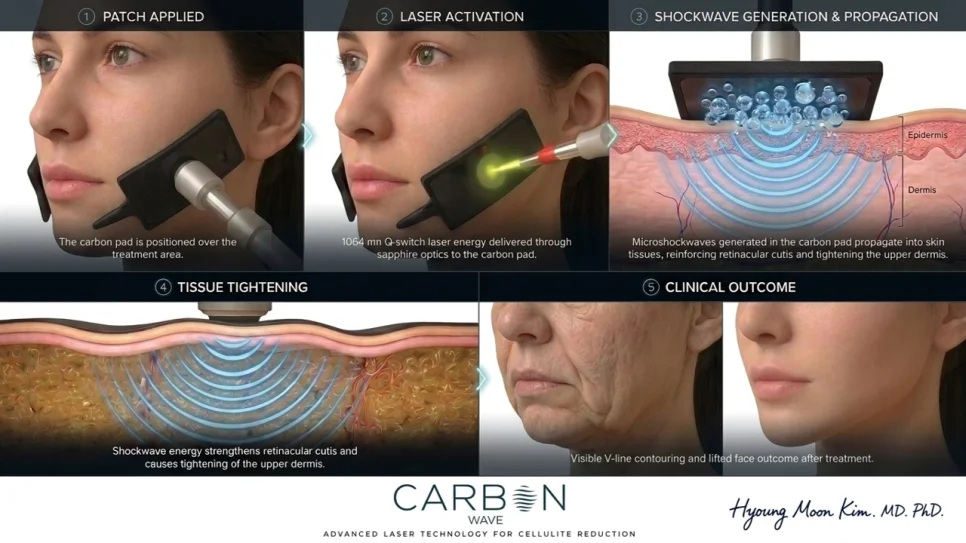
A thin black carbon patch is placed on the skin and a 1064 nm Q-switched laser is fired onto it. The carbon absorbs the light in a few billionths of a second, and because the energy is trapped in the thin patch, it is released as a pressure wave that travels into the skin. The easiest way to picture it: the skin is tapped by a pressure wave rather than heated.
The patch is cut to follow the curve of the jawline, the neck or a body area, so the treated area follows the contour you and the doctor plan. The treatment uses laser systems that are already widely used, with the patch doing the targeting.
How it works
Why a carbon patch
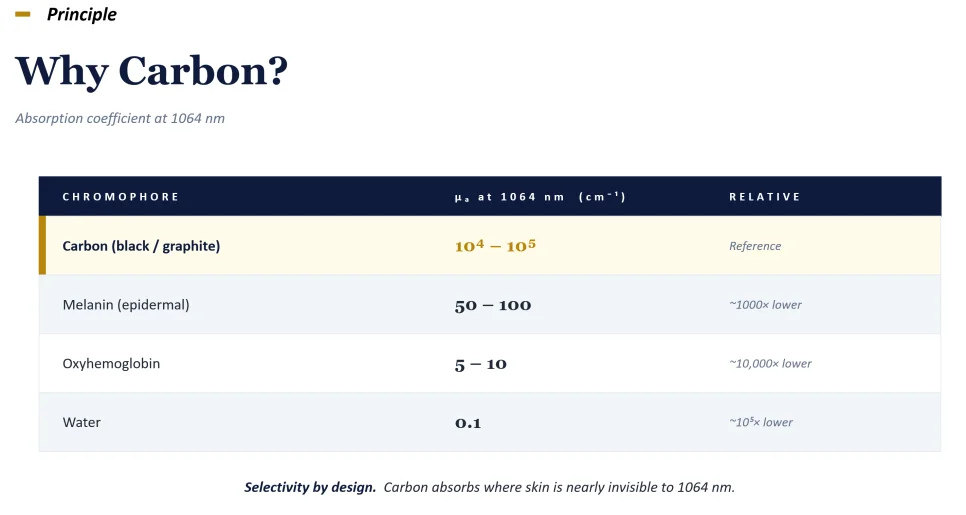
Skin barely notices 1064 nm light. Water, haemoglobin and melanin absorb very little of this wavelength, so on its own it passes through. Carbon is the opposite: it absorbs hundreds to a thousand times more than melanin and far more than blood or water. The patch takes the energy; the skin around it does not. That selectivity is the first safety feature of the treatment.
Light, then heat, then pressure, then a wave. Each laser pulse lasts only nanoseconds. The carbon heats instantly, but the expansion is trapped — physicists call this stress confinement — and it is released as a pressure wave travelling inward.
A signal to the cells that make collagen. In the dermis, the wave physically stimulates fibroblasts. Cells respond to this kind of mechanical signal (mechanotransduction) by producing type I and type III collagen and reorganising the dermis. The stimulus takes a fraction of a second; the response builds over weeks.
Shockwave vs heat-based lifting
Compare before you choose
They work at different depths, which is why they are often planned together rather than instead of each other.
Carbon shockwave lifting
Energy
Laser-generated pressure waves
Depth
Dermis — skin quality and surface firmness
Best for
Texture, elasticity, tightening along the jawline and neck
Needles
None
HIFU and RF
Energy
Focused ultrasound or radiofrequency heat
Depth
Deep dermis to the SMAS layer (ultrasound)
Best for
Deeper laxity and structural lifting
Needles
None
Read more on Ultherapy, Thermage or browse all our devices.
01
Treatment Process
Where it is used
During the visit
- The doctor examines your skin and agrees the areas and approach with you; there is no one-size protocol.
- The carbon patch is cut to the contour of each area and placed on clean skin.
- A layer of gel and a sapphire optic go on top of the patch.
- The 1064 nm Q-switched laser is passed over the patch, area by area.
- The patch and gel are removed and the skin is cleaned.
Afterwards
- There are no needles, so there are no needle marks and little to no downtime. Most people go straight back to their day.
- Your doctor tells you what to expect for your skin and any aftercare before you leave.
- The number of sessions and the spacing between them are planned at the consultation.
02
Before you decide
It may suit you if
It may not be the right treatment if
Deeper laxity is usually better served by focused ultrasound or RF, and volume by fillers. Matching each layer to the right tool gives the best result.
03
What to expect
Timing. The pressure wave lasts a fraction of a second, but the collagen response builds gradually over the following weeks.
Degree. This is a dermis-level treatment: better texture, elasticity and surface firmness. It does not lift the SMAS layer, and doubling the energy does not double the depth — pressure waves fade quickly as they travel.
Combining. It is often planned alongside HIFU or RF for the deeper layers, and fillers for volume.
Risks. Any treatment can cause temporary redness or sensitivity. Your doctor explains the risks for your skin before anything is done. Your eyes are covered and protected, and the eye area is not treated.
Results differ from person to person. Nothing on this page is a prediction of your own outcome, and it does not replace a consultation. See our Medical Disclaimer.
Shockwave lifting in Seoul: planning it around a trip
Easy to fit in. With no needles and little to no downtime, it fits into a short stay, including alongside other treatments in the same visit.
Combine at one consultation. If you are also considering HIFU, RF or fillers, tell us before you arrive so the order and timing can be planned together.
About price. The cost depends on the areas and how much treatment is planned. You get a clear quote after the consultation, before anything is done.
04
FAQ
Is this the same as shockwave therapy for tendon or muscle pain?
No. Conventional shockwave therapy (ESWT) generates pressure waves with a mechanical source inside the device. Here the wave is generated at the skin surface by a laser pulse on a carbon patch.
Does it use heat or needles?
No needles. The laser energy is absorbed by the carbon patch and released as a pressure wave, so the skin is not heated directly the way it is with RF or HIFU.
Can it replace Ultherapy or Thermage?
Not for deep sagging. Shockwave lifting works at the dermis; focused ultrasound reaches the SMAS. They are complementary, and we often plan them together.
How many sessions do I need?
It depends on your skin and the areas treated. The doctor recommends a number and the spacing at the consultation.
How much does it cost?
The cost depends on the areas and how much treatment is planned. You get a clear quote after the consultation, before anything is done.
From our channels

YouTube · from our channel
What to watch out for when botox is combined with energy devices
YouTube short on combining botox with energy-based devices
Watch on YouTube →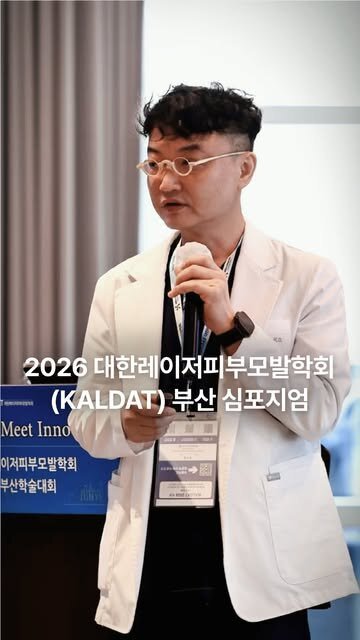
Instagram · from our channel
Dr. Kim on carbon shockwave lifting, KALDAT Busan 2026
Instagram reel of Dr. Kim lecturing at the KALDAT Busan symposium
Watch on Instagram →Not sure shockwave lifting is what you need?
That is what the consultation is for. We look at your skin and tell you which treatment we would use, which we would not — and whether the honest answer is a different treatment, or nothing for now.
Book a consultationGeneral information, not medical advice for your individual case. Device approvals and indications differ by country. Device names are trademarks of their manufacturers. See our Medical Disclaimer and Medical Review Process.
Written at Maylin Clinic Apgujeong, where every consultation is held in English. Read how the clinic works or how to find us.